
場地(Context)
項目改造的原建築的曆史可以追溯到1895年,蘇州蘇綸場當時由兩江總督兼南洋通商大臣張之洞創辦,原建築名字為蘇綸紗廠,前身是蘇州第一家現代化的紡織工廠。原建築在20世紀經曆了多次擴建和改造之後,紗廠最終在2005年宣告破產。2012年,此處整個園區裏的所有建築都經曆了一個完整的改造,整體轉型成為一個城市商業綜合園區進行使用。
The history of the original building in this project dates back to 1895, when the Suzhou Silk Spinning Factory was founded by Zhang Zhidong, the Governor of Liangjiang and the Minister of the Nanyang Trade. It was the first modern textile factory in Suzhou. The original building underwent multiple expansions and renovations throughout the 20th century before the factory was declared bankrupt in 2005. In 2012, a comprehensive renovation was carried out across the entire industrial park, transforming it into a mixed-use urban commercial complex.
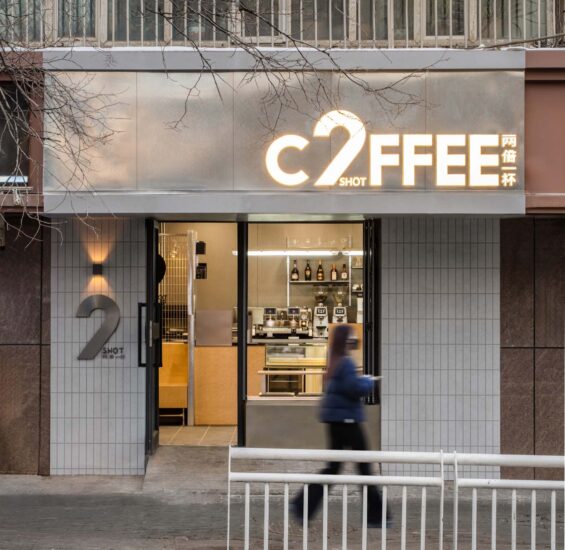
∇ MARUS COFFEE前立麵,MARUS COFFEE facade © 陳逸帆

蘇州這個城市原本地域建築的特性是鮮明的,我們將園林建築中的“亭”“廊”“景”等三大元素,抽象出空間本質之後,想去與原建築本身自帶的一些屬性去進行結合。原建築底層有一排隱形存在的柱廊,2012年的那次改造將原本的柱廊弱化,立麵均被玻璃幕牆封閉上,從而劃分出了清晰的室內室外空間。
Suzhou, as a city, has distinctive regional architectural characteristics. We abstracted three key elements from traditional garden architecture—“pavilions,” “corridors,” and “views”—and sought to combine these elements with the inherent attributes of the original building. The lower floor of the original structure contained a row of hidden columned corridors, which were downplayed in the 2012 renovation, and the facades were enclosed with glass curtain walls, thereby clearly separating the interior and exterior spaces.
∇ MARUS COFFEE平麵圖,MARUS COFFEE Plan © Atelier IN

∇ MARUS COFFEE前入口屋簷,MARUS COFFEE Front entrance eaves ©Atelier IN

所以我們在拿到原始圖紙後的第一件事,是想要去回應最初因諸多原因而消失掉的柱廊和留存於立麵的灰空間。我們的原始出發點是還原立麵本該存在那一個灰空間,但是未經轉譯的空間性還原顯得些許直白與傲慢。最終在對比多個方案之後決定以下圖的方式去放置一個“亭”。原先的玻璃幕牆被替換成為了鍍鋅板,柱子以嵌入的方式去呈現,而傾斜挑出的屋頂在向外為客人或路人提供灰空間的同時,也讓一層底商在立麵上的呈現狀態從最初沿街的廊道延展成為嵌入整個樓體的體塊,也就是所謂的“房子”。
Therefore, the first task upon receiving the original drawings was to respond to the columned corridors that had disappeared for various reasons and the residual “gray space” on the facade. Our initial approach was to restore the gray space that should have existed on the facade, but this direct restoration of the space felt somewhat simplistic and imposing. After comparing multiple proposals, we decided to use the following design approach, illustrated in the axonometric view, to place a “pavilion.” The original glass curtain walls were replaced with galvanized steel panels, and the columns were presented in an embedded manner. The inclined, cantilevered roof not only provides gray space for visitors or passersby but also transforms the commercial spaces on the ground floor, extending the facade from the original street-side corridor into a volume embedded within the building, thus forming what we call the “house.”
∇ MARUS COFFEE立麵分析圖,MARUS COFFEE elevation analysis drawing © Atelier IN

亭(Pavillion)
亭中的“駐足”
Lingering in the pavilion
所謂“亭”,被定義為有屋頂,屋頂之下不完全封閉的一種帶有歡迎人停留屬性的一種建築物。我們在整體空間中置入了兩個不同屬性的“亭”。第一個是從立麵向外延伸的斜屋麵,實際並未切斷於立麵,而是斜插在立麵之上,在室內能夠感知到斜屋頂的穿插關係。這個未被切斷的斜麵在純粹的符號性上便與牆麵裝飾脫離,使其成為了一個即是立麵本身,也是抽象意義上的“亭”,具有了屬於亭的空間性。
The so-called “pavilion” is defined as a structure with a roof, where the space beneath the roof is not fully enclosed, and it has an inviting quality that encourages people to linger. As shown in the diagram, we have incorporated two pavilions with different characteristics into the overall space. The first pavilion is an inclined roof that extends outward from the facade. It does not detach from the facade but instead slopes over it, creating an interplay between the inclined roof and the interior space. This undetached inclined surface, in its pure symbolism, distances itself from the decorative elements of the wall, transforming it into both a part of the facade and, in an abstract sense, a “pavilion,” thus giving it a pavilion-like spatial quality.
∇ 亭與廊的表達,pavilion diagram ©Atelier IN

∇ 亭下的空間,The space under the pavilion © 陳逸帆

亭中的“表演”
performance in the pavilion
第一個“亭”是關於場地的,第二個“亭”則是聚焦於咖啡師與客人之間的狀態。”亭“中通過圍合的吧台,將“亭”屋簷下的空間分成了兩個部分,一部分空間是屬於咖啡師的,一部分空間是屬於客人的。居中布置的回型吧台是屬於咖啡師的一方天地,可以理解為是屬於咖啡師的表演“舞台”,能夠在有一定圍合感的空間裏同時進行操作出品和保留與客戶之間充足的對話性。而吧台外,“亭”的屋簷和屋簷下的四根立柱之間的虛空間,則是屬於客人的,兼具依舊位於亭下場所的歸屬感和圍坐觀看舞台中心的體驗感。
The first “pavilion” is related to the site, while the second “pavilion” focuses on the interaction between the barista and the customer. Within the “pavilion,” the space under the eaves is divided into two parts by an enclosing bar counter: one part belongs to the barista, and the other part belongs to the customer. The centrally located oval bar counter is the barista’s domain, which can be understood as the barista’s performance “stage.” It allows the barista to both prepare and serve coffee while maintaining an adequate sense of enclosure and enough space for interaction with the customer. Outside the bar counter, the space between the eaves and the four columns beneath them is reserved for the customer. This area offers both a sense of belonging to the pavilion and the experience of sitting around and watching the “stage” at the center.
∇ 入口看向吧台及休閑區,Entrance looking towards the bar and lounge area ©Atelier IN

此處內容需要權限查看